

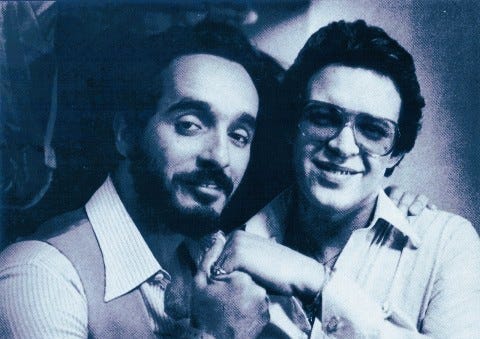
It is not hyperbole to say that without Willie Colón, Héctor Lavoe, and Rubén Blades (along with such august forerunners as Machito, Ismael Rivera, Celia Cruz, Tito Puente, Eddie Palmieri, and so many others), there would be no Bad Bunny today.
Urban Latin music in the United States has always been about polyrhythm, dance, celebration, cultural politics, and social struggle, all rendered in a compelling narrative voice. And the insouciant dance music that came to be known as salsa owes much to Willie Colón, Héctor Lavoe, and Rubén Blades. This hour of Jazz Roots & Branches offers a pocket sampling of their considerable legacy.
The excitement and enthusiasm these artists could conjure is evident in the video (link below) of Rubén Blades and Celia Cruz with the Willie Colón Orchestra, performing to a raucous house at the Capitol Theatre in Passaic, New Jersey on 22 March 1980. The grainy footage is one more reminder that the Latin American presence in the territorial United States runs many generations deep, and has never been an “invasion.” It just took the demagogues to perceive an opportunistic nightmare of their own confection, postulating a conspiracy of internal enemies through the shadowy grain. If you know, you know.
As on that night in Passaic, so it was when Rubén Blades y Seis del Solar appeared at San Francisco’s Great American Music Hall in 1985, touring behind the ensemble’s then-new release, Buscando América, an essential Blades title. There we were, searching for an America consonant with our aspirations and lived experience, as I and my friends (you know who you are) jostled, joyously, to keep from being separated by the dancing mania, something akin to the Times Square New Years crush before the advent of panoptic SWAT-team crowd control.
At the height of the fervent Central American anti-intervention movement in the Bay Area, had the fire marshal and police been present (they likely knew better), they would have been compelled to shut the concert down, impossible though that may have been. You had to be there, and glad we were.
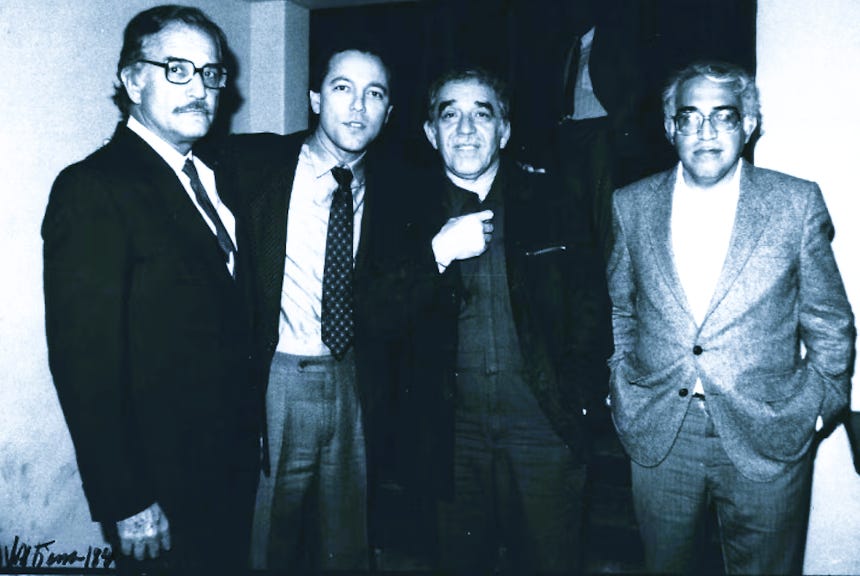
Gabriel García Márquez was a great admirer of Blades’ quotidian topical orientation and evocative literary imagery. He complimented Blades in relating that he would have liked to have written “Pedro Navaja” himself, one of the singer’s most emblematic songs, first recorded with Willie Colón on Siembra (1978), coincidentally the best-selling salsa album of all time.
A social-realist allegory (like so many Blades compositions), sung to the Brecht-Weill tune “Mack the Knife,” Navaja is a preening street-tough bully with a gold tooth, a threatening mien, and a concealed switchblade, a narcissist dandy who attacks a streetwalker one night and ends up dead on the sidewalk, to the dismay of no one in the barrio, where locals profess neither knowledge nor witness of the particulars of Navaja’s furiously epic demise.
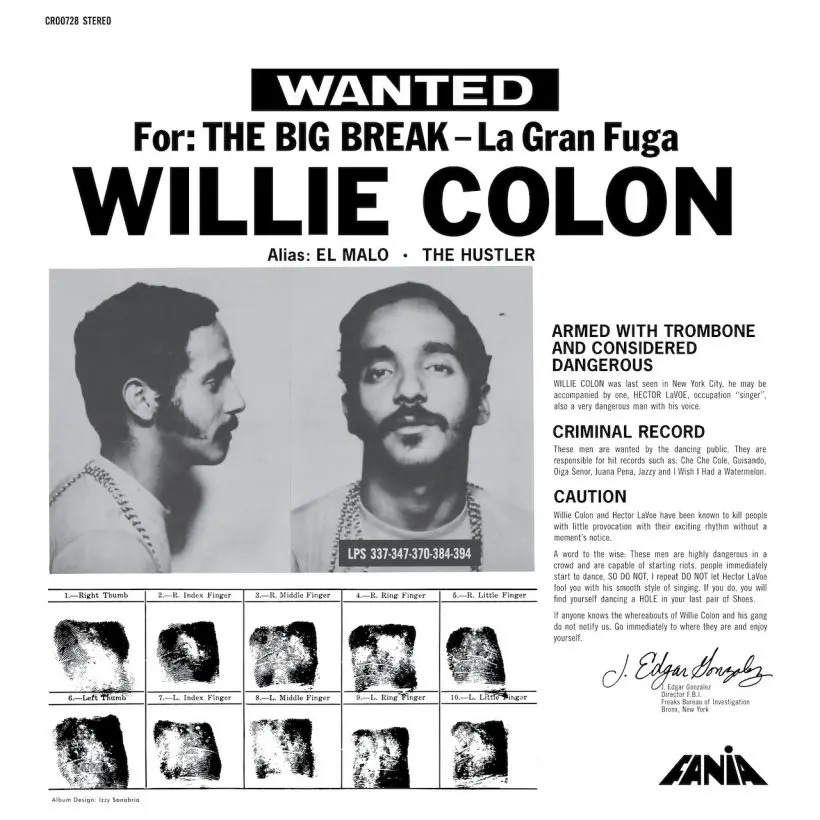
And so, this hour’s outro is “20 de diciembre,” Blades’ response to rote U.S. regime-change adventures, as in the bombardment of his Panamanian homeland (20 December 1989), chronicle of a failure foretold. We might thus ponder the current kneejerk edition, Operation Epic Fury. In the cautionary refrain of “Pedro Navaja”: “La vida te da sorpresas — life gives you surprises.” Live by the sword, die by the sword, o sea, una crónica de una muerte anunciada. Who is that shock-and-awe predator on the wanted poster now? Tanto tiempo, tanta historia.
Title | Artist | Album | Composer | Label
Che Che Colé | Willie Colón & Héctor Lavoe | Cosa Nuestra | Willie Colón | Fania
La Murga | Willie Colón & Héctor Lavoe | Asalto Navideño | Willie Colón; Héctor Lavoe | Fania
Guaracha | Willie Colón, Rubén Blades & Héctor Lavoe | The Good, the Bad & the Ugly | Willie Colón | Fania
El Cazangero | Willie Colón, Rubén Blades & Héctor Lavoe | The Good, the Bad & the Ugly | Rubén Blades | Fania
Pablo Pueblo | Rubén Blades & Willie Colón | Metiendo Mano | Rubén Blades | Fania
Siembra | Rubén Blades & Willie Colón | Siembra | Rubén Blades | Fania
Tiburón | Rubén Blades & Willie Colón | Canciones del Solar de los Aburridos | Rubén Blades | Fania
Buscando América | Rubén Blades y Seis del Solar | Buscando América | Rubén Blades | Elektra
El Padre Antonio y el monaguillo Andrés | Rubén Blades y Seis del Solar | Buscando América | Rubén Blades | Elektra
20 de diciembre | Rubén Blades | Tiempos | Rubén Blades | Sony Discos
La vida te da sorpresas
Sorpresas te da la vida, ¡ay, Dios!


